
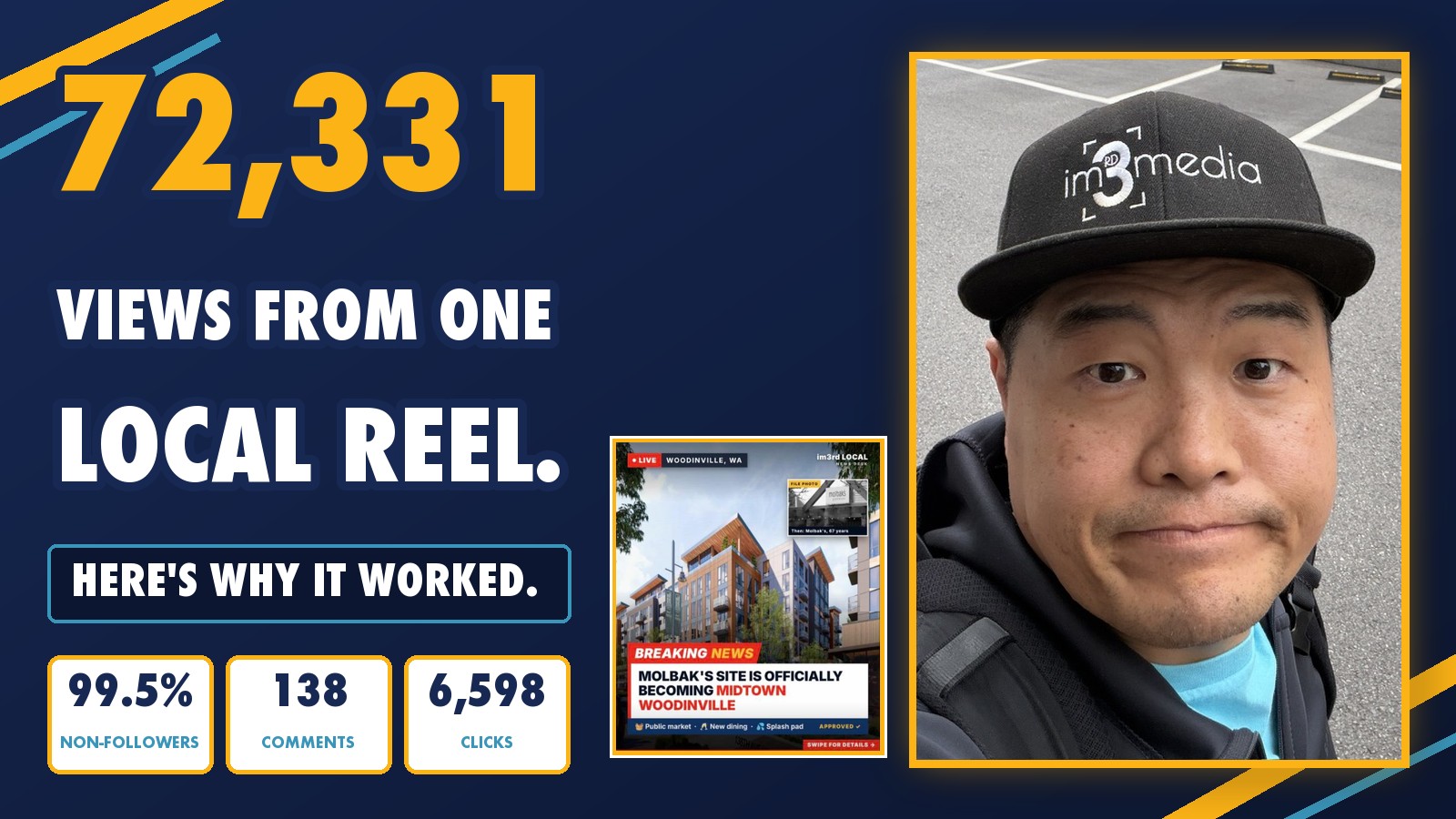
Short answer: The reel worked because it led with a local story people already cared about, put it in a familiar news format, gave people an easy reason to react, and mentioned the listing last. It was not a listing post. It was a neighborhood post with a listing attached.
Three weeks ago we posted a Reel about the old Molbak's site in Woodinville becoming Midtown Woodinville. It did far better than our typical posts. Here is what the numbers look like today, straight from our Facebook Insights:1
- 72,331 views from 57,832 viewers
- 7,039 engagements, including 6,598 clicks, 219 reactions, 138 comments, and 38 shares
- 99.5 percent of the people who watched did not follow our page
This post breaks down what we think happened and what you can copy. We are being honest about one more thing up front: this is one reel, and nobody outside Facebook can see its exact formula. What follows is our analysis, not a guarantee.
What was in the reel?
It was a 30-second "news desk" Reel with five short local stories, styled like a TV broadcast. You can watch the reel on Facebook and read the comments for yourself. A "Live: Woodinville, WA" tag and a "Story 2 of 5" counter ran across the top, and a ticker at the bottom said what was coming up next.
The lead story was a "Breaking News" item: the old Molbak's site is officially becoming Midtown Woodinville, with a public market, new dining, and a splash pad. Then came a walking and biking bridge into downtown, a new trail linking 175 miles of trails, a new park stage, and a winery changing hands.
The listing was the last thing we mentioned. The caption ended with a single line saying that if you are thinking about living nearby, there was a home ready for a viewing, and the link went in the first comment.
Why did people stop scrolling?
The topic had a lot of feeling attached to it. For years, people in Woodinville wondered what would happen to that empty lot. When the story broke, the top comments were not about the video. They were people remembering what the place meant to them, a community garden, a place to eat, the holidays.
You can see it in the reactions. Of the 219 reactions, 103 were likes, 64 were sad, and 40 were angry. Almost half (104 of 219) were sad or angry. That does not mean the reel was bad. It means the story touched something. People do not react that strongly to a graphic that says "Just Listed."
This is the idea from our first post in action: nobody cares about your listing, but people care a lot about their community.
Why did Facebook show it to so many strangers?
Of the 72,331 views, only about 0.5 percent came from followers, which is 357 people. The other 71,920 were not following us. And 96 percent of views came from the main Feed, not the Reels tab.
Facebook does not publish its exact formula, so this part is our best read. When people react, comment, and share early, Facebook shows the post to more people like them. Views climbed steeply in the first day or two and flattened after about five days, which is the shape of a post that got picked up by the feed and then ran its course.
The lesson is that on Facebook, a small page can reach a large audience when the content gives people something to do: react, argue, remember, tag a neighbor.
Did people actually watch it?
Many did not, and that is normal. The average watch time was 9 seconds on a 30-second reel, and the average viewer watched 28 percent of it. About 38,600 views (a little over half) lasted at least 3 seconds. The biggest drop-off was at the 4-second mark, and 8.9 percent of views reached the 20-second mark.
But the people who stayed really stayed. Total watch time added up to more than 146 hours. The multi-story format likely helped. A new story every few seconds gives people a fresh reason to keep going, and the "Up Next" ticker promised more.
What we would test: the drop at 4 seconds may be the moment the first story ends. A tighter first story, or a stronger hook into the second, might keep more people.
Who watched?
About 83 percent of viewers were 35 or older. The biggest groups were 35 to 44 (24.9 percent) and 45 to 54 (23.1 percent), followed by 55 to 64 (18.7 percent) and 65 and up (16.3 percent). Under 35 made up about 17 percent combined.
For a real estate team, that is the right crowd. They are homeowners, long-time residents, and the people who will sell a home in the next few years. They are not the typical "scroll for fun" audience, and they remember the neighborhood.
What got people to comment?
Two things. The caption asked a direct question: "Which one are you most excited for? Drop it in the comments." And the story itself had a person behind every comment, someone with a memory or an opinion about that exact place. We also pinned a comment about the city's public open house on the trail plans, which gave people something useful to do, not just react to.
Where did the listing fit?
At the very end, in one line, with the link in the first comment instead of the caption. That follows the formula we recommend: get their attention, give them value, then mention the listing. By the time anyone read about the home, they had already received something useful.
If you want to see the home from the reel, it is at 22632 NE 143rd Ct in Woodinville, listed by Patti and Bradley Chalker of Chalker Realty, powered by John L. Scott. Here is its listing showcase site: woodinvillegardenhome.com. We tagged that link so we can see how many visits come from this post.
What did not happen?
We want to be straight about this too.
- Views are not leads. About 57,800 people watched and only 32 followed the page. That is a very small share. If you want local reach to turn into relationships, you have to ask for the follow and give people a reason to stay.
- The "clicks" number is not link clicks. Facebook's click count can include taps that are not on the link, such as expanding the caption, and we cannot see a breakdown. So the 6,598 clicks are not 6,598 visits to the listing. To measure what the listing earned, you need your own link tracking, such as a listing showcase site with visitor stats.
- We cannot prove why it worked. Several things happened at once. We cannot separate the topic from the format from the timing.
What is the playbook you can copy?
- Pick a local story people already care about. A beloved place changing, a new project, a road or park. Look for stories that make people say "finally" or "wait, what?"
- Check every fact. Use the city, the developer, or the news report. A news-style format raises the stakes. If you get it wrong, you lose the trust you were building.
- Use a format people recognize. A news desk look, a "story 2 of 5" counter, and a ticker all say "this is quick and worth watching."
- Give it more than one story. Several short stories reset attention every few seconds.
- Lead with the strongest story in the first 3 seconds.
- End the caption with a question that people can answer from their own experience.
- Put something useful in a pinned comment, like an event date or a public meeting.
- Mention the listing last, in one line, and put the link in the first comment.
- Track what happens. Watch followers, comments, and link visits, not just views.
A note on honesty: a news-style design is a design choice. You are not a news organization, so do not present yourself as one, and check your MLS and brokerage rules before you post.
What if you do not have time for this?
Making a reel like this every week takes research, scripting, design, and editing. At im3rd Media, we post about your neighborhood every day and your listing rides along, so you do not have to build it yourself. But whether you do it or we do, the idea is the same: be the local source first, and let the listing ride along.
Frequently asked questions
Did a local news reel really get 72,000 views?
Yes. Our Facebook Insights showed 72,331 views and 57,832 viewers three weeks after posting, with 99.5 percent of viewers not following the page.
Do real estate agents need a big following to go viral locally?
No. Only about 0.5 percent of the views on this reel came from followers. The reach came from people who saw it in their feed and reacted, commented, or shared.
Why did so many people react with sad or angry emojis?
The story was about a place many people cared about. Strong reactions, even negative ones, show that a topic matters to people. They are not a sign the content failed.
How do you turn views into listings?
Put the listing last, link to it in the first comment, and track visits on a listing showcase site. Then ask for follows, so the next local post reaches the same people again.
Footnotes
-
im3rd Media Facebook Insights for the reel, as of November 12, 2026, about three weeks after posting. Facebook's "clicks" can include taps other than link clicks, such as expanding the caption. ↩